
Crypto Broker Fees: Hidden Costs to Watch in 2026
Beyond trading fees: spreads, withdrawals, and embedded costs that eat into your crypto profits

What are the main hidden costs in crypto broker fees?
The biggest hidden crypto broker fees include spread markups on instant purchases (2-5%), inflated withdrawal fees, funding rates on leveraged positions, and currency conversion costs that can add 1-3% per transaction.
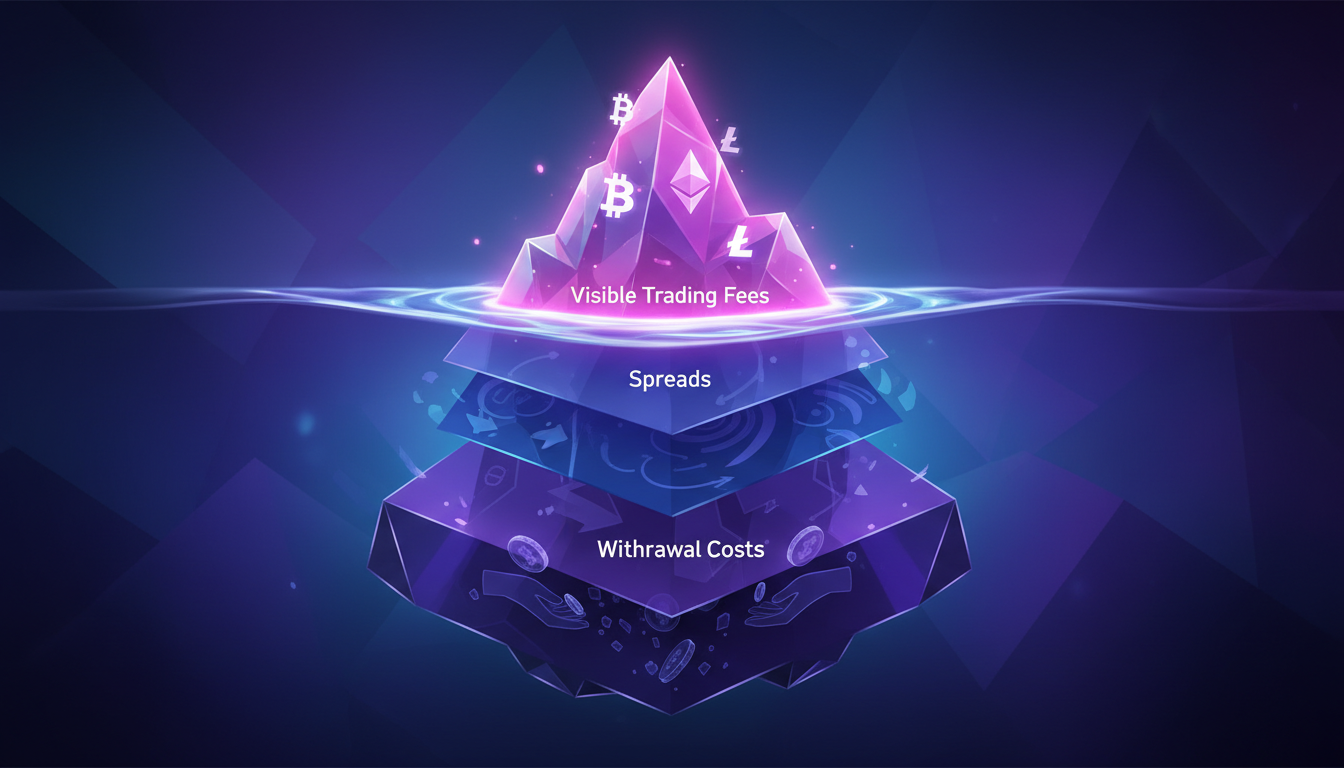
The 2026 Fee Landscape: What's Changed
The crypto broker fee game has evolved dramatically. What started as straightforward commission structures has morphed into a complex web of costs that catch even experienced traders off guard.
This shift accelerated in 2026 as regulatory pressure from the EU's MiCA implementation and the US SEC-CFTC harmonization initiative pushed brokers toward more formal disclosures. But here's the catch: better disclosure doesn't mean simpler pricing. If anything, fee structures have become more sophisticated at hiding costs.
The new reality: headline trading fees are often meaningless. A broker advertising 0.1% trading fees might actually cost you 2-3% per trade once you factor in spreads, conversion rates, and withdrawal costs. This is particularly true for beginners who rely on 'simple' features like instant buy buttons.
Recent data shows Bitcoin transaction fees averaging $8-15 during normal periods, yet many brokers charge $25-50 for withdrawals. Meanwhile, funding rates on popular crypto perpetuals can run 0.01-0.03% every eight hours - that's potentially 1% per month just for holding a leveraged position.
The Spread Trap: Where Most Costs Hide
Analysis of major crypto platforms reveals that spread markups represent the largest hidden cost for retail traders. When you click 'Buy Bitcoin' on most user-friendly interfaces, you're not trading at market price - you're paying a markup that's embedded in the conversion rate.
Here's how it works: while the Bitcoin market might show a spread of 0.02% between bid and ask, your 'instant buy' price includes an additional 1-4% markup. This isn't disclosed as a fee - it's simply built into the rate you see.
The numbers tell the story: A $1,000 Bitcoin purchase through a convert feature might cost you $30-50 in hidden spread costs, compared to $1-5 if you used the same broker's advanced order book. That's a 10x difference for the convenience of clicking one button instead of placing a limit order.
Funding Rate Reality
For traders using leverage, funding rates have become the silent profit killer. Popular crypto perpetuals charge funding every eight hours, typically ranging from -0.05% to +0.15%. On a volatile day, you might pay 0.3% just to hold a position - more than most brokers charge in trading fees.
What makes this particularly insidious is that funding rates aren't fixed. During the March 2026 crypto rally, some perpetual contracts saw funding rates spike to 0.5% per funding period. Hold a leveraged Bitcoin position for three days during high volatility, and funding costs alone could exceed 4% of your position size.
Critical Fee Audit
Withdrawal Fees: The Profit Drain
Network fees provide perfect cover for brokers to inflate withdrawal costs. While actual Bitcoin network fees fluctuate between $2-20 depending on congestion, many brokers charge fixed withdrawal fees of $25-50 regardless of network conditions.
The justification is operational costs and batching, but the math doesn't add up. Even accounting for custody, compliance, and processing costs, the markup is substantial. Some platforms charge $30 to withdraw Bitcoin when the network fee is $3 - a 10x markup that's pure profit.
The Conversion Cost Multiplier
Currency conversion represents another layer of hidden costs that's particularly relevant for global traders. If you deposit USD but your account operates in EUR, or you're trading crypto pairs quoted in different base currencies, conversion costs compound quickly.
Most brokers don't publish their FX spreads, but testing reveals markups of 0.5-2% above interbank rates. For a trader making multiple currency conversions per month, this easily adds up to more than their total trading commissions.
The subscription shift: Several major platforms have introduced tiered subscription models where 'zero fees' require monthly payments. A $30/month subscription might save you money if you're trading large volumes, but for smaller traders, it just shifts costs from per-transaction to fixed monthly fees.
Practical Cost Management in 2026
The fee landscape might be complex, but informed traders can significantly reduce their costs with the right approach. The key is understanding where each type of cost hits hardest and adapting your trading behavior accordingly.
For frequent traders: Focus on order book execution over instant buy features. The learning curve is worth it - you'll typically save 2-4% per trade by using limit orders instead of market buys. Most platforms offer the same liquidity through both interfaces, but the pricing is dramatically different.
For position holders: Pay close attention to funding rates if you're using leverage. A position that's profitable on paper can become a loss purely through funding costs. Consider closing and reopening positions when funding rates spike above 0.1% per period.
Network Optimization
Withdrawal timing can save substantial money. Bitcoin fees during Asian trading hours are often 30-50% lower than during US market hours. For larger withdrawals, the difference between peak and off-peak network fees can be $20-30.
Layer 2 solutions and alternative networks offer another cost-reduction strategy. Where available, withdrawing USDC on Polygon or Arbitrum typically costs under $1 compared to $10-25 on Ethereum mainnet. However, verify that your destination wallet supports the network you're using.

Crypto Broker Fees FAQ
What's the difference between trading fees and total trading costs?
Why do instant buy features cost more than order book trading?
How can I minimize crypto withdrawal fees?
What are funding rates and when do they apply?
Are zero-fee crypto brokers really free?
How do currency conversion fees affect crypto trading?
What should I look for in a broker's fee disclosure?
Sources & References
- [1] MEXC Trading Fee Updates - DOGEUSD and ADAUSD Futures - MEXC Global (Accessed: Feb 18, 2026)
- [2] SEC and CFTC Relaunch Project Crypto as Joint Harmonization Initiative - Sheppard Mullin (Accessed: Feb 18, 2026)
- [3] Crypto Convert Fees 2026: Understanding Hidden Costs - Cryptal (Accessed: Feb 18, 2026)
- [4] Bitcoin Average Transaction Fee - YCharts (Accessed: Feb 18, 2026)
- [5] Crypto Transaction Fees Explained - BitGo (Accessed: Feb 18, 2026)
- [6] MiCA CASP License Requirements and Pricing Policy Documentation - Fintech Arbor (Accessed: Feb 18, 2026)